

Get to Know Me (and My Conditions)
- May 18, 2018
- 6 min read
My name's Eliot, as you likely picked up from the introduction on my homepage, and like I mentioned in said introduction I'm 20 years old and more fragile than my Grandmother. I've recently been diagnosed with Ehlers Danlos Syndrome (EDS) after searching or answers for 8+ years. EDS is a genetic connective tissue disorder affecting the body's creation and synthesization of collagen. For those of you who don't have EDS or HSD, and have never been to medical school, you're probably curious as to why I'm talking about what half of the drug store skin care aisle is plastered with - collagen. In short, collagen is the primary protein that makes up the different tissues in your body. You see it all over anti-aging products because as you age, your (healthy) collagen breaks down and you skin becomes more lax and wrinkly. Well it's not just the collagen in your skin that's breaking down, it's likely that your ever present sore back, need for reading glasses, and that one knee that squeaks when it rains are all caused by a break down of your collagen.
EDS and Collagen: More than Anti-Aging Creams
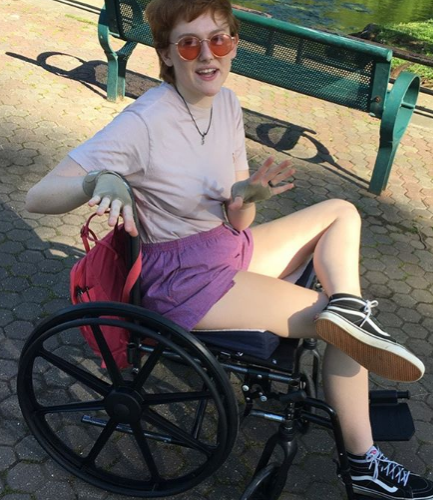
EDS on the other hand means that my collagen was made wrong from the get, and every single system in my body is or will be affected by it. The most noticeable symptom, the one that can't really be explained any other way, is joint hypermobility. When I tell people this, the images that come to mind range from an esteemed yogi twisting their body into a pretzel, or a prima ballerina twisting and turning and leaping in ways you previously thought were impossible. If that's what you thought of, you're thinking about flexibility and not hypermobility. Sure, yogis and ballerinas likely have a few hypermobile joints, but it came as a result of stretching their ligaments and tendons as well as their muscles for years and years, and even then it's a very different kind of hypermobility. People with EDS aren't always flexible, most of us aren't, but due to faulty collagen the ligaments that hold our joints into place don't bounce back when stretched. Over time, as our ligaments begin to stretch more and more, we start to experience dislocations and subluxations (when a joint comes partially out of place without fully dislocating). Because our ligaments are so stretchy, these dislocations might hurt or be uncomfortable, but they don't destroy tendons and muscle in the same way they would in a healthy person. It hurts when I dislocate my knees, but it doesn't shred my ACL. Due to the pain that we do experience due to frequent dislocations, muscle weakness due to overworked muscles trying to do our ligaments' job, and general instability and risk of falls, many people with EDS use mobility aids such as braces, canes, walkers, and wheelchairs. Personally, I use a combination of braces, a cane, and a wheelchair.







More than Hypermobility
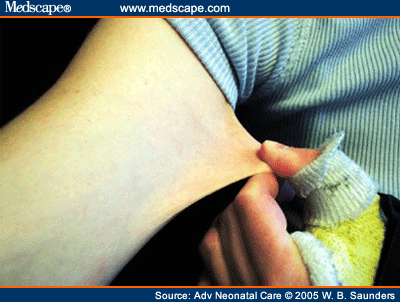
While joint hypermobility is the most noticeably defining factor of EDS, it is far from the only symptom. If collagen is in all tissue, and all organ systems are made up of said tissue, any fault in collagen is fault in every area of the body. Another common symptom seen in many (but not all) patients is skin fragility and skin elasticity. Many EDS patients can stretch their skin further than you'd like to imagine without causing us any harm or major discomfort. Some of us are more stretchy than others; some of us are stretchy in a few areas, some of us are stretchy everywhere; and some of us aren't really stretchy at all. Each person is unique. The fragile aspect of our skin means that many of us bruise easily, cut/scratch/scrape easily, and take much much longer to heal. The nature and severity of it, again, varies from person to person.
Moving on to other body systems, common conditions that EDS can cause include: Postural Orthostatic Tachycardia Syndrome (POTS), Gastroparesis, Mitral Valve Prolapse, Mast Cell Activation Syndrome, Irritable Bowel Syndrome, Chiari Malformation, Asthma, Arthritis, Osteoporosis, Poor Vision, Poor Hearing, Varicose Veins, Chronic Fatigue, Migraines, Endometriosis, Bleeding Disorders, Electrolyte Imbalances, Seizure Disorders/Epilepsy, Cerebral Spinal Fluid Leaks (CSF leaks), Scoliosis, and more conditions than I have the energy to recall and type.
Soooo.. What's Wrong with You?
Personally I've been blessed with a confirmed case of POTS, a Seizure disorder, migraines, asthma, varicose veins, as well as suspected cases of gastroparesis and endometriosis. I hope that seeing that partial list of conditions EDS can cause is explanation enough as to why most of us take handfuls of pills a day.
Living (and Fainting) with Dysautonomia
Let's move on for a moment to my new worst enemy I mentioned above, POTS. Postural orthostatic tachycardia syndrome is a disorder of the autonomic nervous system that causes all sorts of trouble. The main issue being this: when a healthy person stands, their autonomic nervous system tells the blood vessels in the extremities to constrict to combat gravity. In a person with POTS, that signal isn't sent, causing blood to pool in our hands and feet. Our heart beats faster and faster, trying to work against gravity to bring blood back up to our brain. Sometimes it works and we just get dizzy, other times it doesn't and we faint. It also leads to temperature intolerances to both cold and heat (though heat exacerbates fainting spells and dizziness). People with POTS have to stay hydrated and up their salt intake to help boost blood volume and relieve symptoms. It's also wise for us to take cooler showers (standing in a hot shower = horrible blood pooling) and to eat smaller, easy to digest meals as heavy meals require more blood flow to the gut causing dizziness.
What's Wrong with You? Part 2: Mental Illness
The last thing I am going to touch on momentarily is mental health. For the longest time, mental illness has been my worst enemy. It has hospitalized me four times, it has pumped me full of psychotropic medications, it has taken an hour out of my week for therapy for years, it has stuck me in psychiatry office waiting rooms, it has tossed me around, scarred me to kingdom come, and nearly taken my life over a dozen times. As is the life of someone who has felt the weight of early onset Bipolar Disorder since I was 9, Borderline Personality Disorder since I was 6, PTSD since I was 13, Complex PTSD since I was 17, and no name for a single one of these symptoms until my parents discovered evidence of severe self injury when I was 14. I'm not going to spend too much time elaborating on these, but I will touch on them quickly. Bipolar Disorder is not a term to describe irregular weather or your fickle mother, it's a severe mood disorder causing episodes of debilitating depression and terrifying mania (ie: your thoughts are racing and the judgement part of your brain that tells you its a bad idea shuts down completely). Borderline Personality Disorder is most commonly caused by prolonged trauma at an early age (as in my case), that causes such severe behavioural changes and means of coping and survival that it shapes your entire personality and you have no sense of self, great difficulty with emotional independence, and bouts of violently explosive emotions (happy, sad, angry, numb, etc). My PTSD was caused by a sexual assault when I was 13, and my Complex PTSD (caused by prolonged, repetitive trauma carried out by an individual who is supposed to be a positive force in your life ie a parent or partner) stemmed from psychological and sexual abuse at the hands of a violent boyfriend when I was 17.
The Grump Behind Chronically Grumpy
To end on a more personal, and more positive note, here are some fun facts about me:
- my birthday is May 11th
- my favorite color has been yellow since I knew what colors were
- I have a slight (read: extreme) obsession with plants and bees
- sunflowers are my favorite flower, and black eyed susans are a close second
- dogwoods are my favorite tree
- lavender, mint, and basil are tied for favorite herb
- I'm a proud succulent mom
- I'm nonbinary
- I have an english bulldog named Mona and a frenchie named Eloise
-both of my dogs could also be classified as chronically ill (Mona has skin and thyroid problems, Eloise has chronic doggie meningitis and receives regular chemo shots as well as daily meds)
- I have the world's most supportive and dorky boyfriend, Keean
- did I mention plants?
Comments